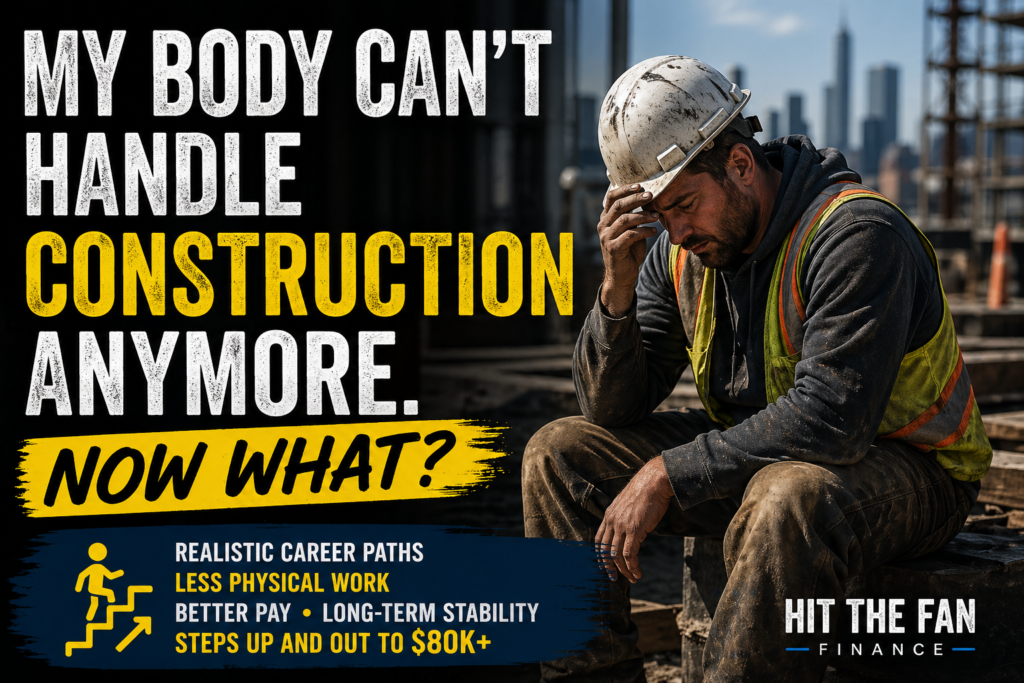
If your body can’t handle construction anymore, you are not weak, lazy, or suddenly “not built for work.” Construction is hard on people. That is not a character flaw. That is gravity, concrete, weather, ladders, tools, deadlines, and the kind of repetitive strain that makes your knees sound like a microwave full of gravel.
The short answer: if construction is wearing you down, the next step is not another body-wrecking job with a different logo on the shirt. The goal is to use what you already know from construction and move toward better pay, less physical damage, more stability, and a real path up.
That might mean estimating, project coordination, safety, inspections, permit work, facilities management, construction tech sales, supplier sales, operations, or another no-degree career path that uses your experience without asking your back to keep doing unnecessary overtime for the next twenty years.
This is not about finding a “nice little job” that keeps you broke. A job that pays just enough to stay struggling but slightly closer to a chair is not the dream. We are looking for a better next step that can eventually lead somewhere. Ideally, somewhere with a real ceiling, better benefits, less damage, and a shot at $80K or more over time.
Key Takeaways
- If your body is done with construction, listen before an injury makes the decision for you.
- Do not treat another low-paying physical job as the fix. That is not a career change. That is changing aisles in the same burning store.
- Construction experience can translate into higher-upside roles like estimating, project coordination, safety, inspections, facilities, supplier sales, technical sales, and operations.
- The best next move should improve at least one major thing: pay, physical strain, stability, schedule, benefits, or long-term career mobility.
- A bridge job is only useful if it buys time, reduces damage, increases pay, or points toward a better path. It is not the destination.
- Before paying for training, check real job postings and make sure the path can actually lead to better money and opportunities.
If Your Body Can’t Handle Construction Anymore, You’re Not Being Dramatic
Construction has a way of making people feel like pain is just part of the job description. Bad back? Normal. Shoulder acting weird? Normal. Feet hurt every night? Normal. Hands numb? Normal. You wake up feeling like you lost a bar fight with a staircase? Also apparently normal.
At some point, “normal” starts looking a lot like “unsustainable.”
A lot of people wait until their body forces the career change. One injury, one medical bill, one long recovery, one boss who suddenly needs “someone who can keep up,” and the whole thing goes sideways fast. Awesome system, right? It’s amazing that a person can spend years building half the town and still be one accident away from financial disaster.
If you are already thinking, “I can’t do this forever,” pay attention to that thought. It is not weakness. It is mind and body telling you it’s time for a change.
And yes, if you are dealing with serious pain, injury, numbness, weakness, or anything that feels medically wrong, talk to a medical professional. This article is career guidance, not medical advice. I am not diagnosing your back. Your back has probably already issued its own press release.
Why Construction Burnout Hits Differently
Construction burnout is not just “I am tired of my job.” Everybody gets tired of work. That is why they have to pay us to go. Construction burnout can come with a physical bill that stacks up year after year.
You are dealing with long days, heavy materials, weather, ladders, lifting, bending, tools, jobsite pressure, inconsistent hours, injury risk, and the general joy of being expected to have the body of a 22-year-old until retirement. Retirement is something that many people in this kind of work do not have the luxury of experiencing.
The scary part is not just the soreness. It is the math. If you are making decent hourly money but have no savings, no retirement cushion, no room for an injury, and no path up, you are not in a stable career. That is why this needs to be a long-term fix, not just a softer landing into another low-ceiling job.
The Sideways Trap: Do Not Trade One Bad Deal for Another
Here is where a lot of career advice gets lazy. It sees “construction worker wants out” and suggests another physical job. Landscaping. Warehouse. Maintenance. Delivery. Retail.
That is not a solution if the core problem is low pay, physical damage, no savings, no retirement, and no long-term ladder.
A lateral move only helps if it does one of four things:
- It pays more right away.
- It reduces physical damage fast.
- It gives you benefits, schedule stability, or breathing room.
- It helps you build experience for a higher-ceiling path.
Otherwise, it is just the same trap that’s keeping you stuck.
That does not mean every bridge job is bad. Sometimes you need a bridge. If a supply house counter role gets you indoors, raises your pay, teaches you materials sales, and gives you a path into outside sales, that can be useful. If a facilities coordinator job gets you lifting less and more vendor management experience, that can be useful. If a permit assistant role gets you into city or county work with benefits, that can be useful.
But the bridge needs to point somewhere. If it does not lead toward more money, less strain, or better stability, it is not a bridge. It is a scenic detour through the same nonsense.
What Construction Experience Actually Proves
One of the biggest lies people absorb after years in physical work is that they “only know labor.” That is usually not true. The problem is that construction experience often gets described in the smallest possible way.
You might say, “I’ve just done construction.” An employer might hear, “Can lift heavy things.” Not useless, but not exactly a retirement plan.
A better translation is this: construction experience can prove you understand schedules, materials, jobsite problems, safety, sequencing, tools, deadlines, customer expectations, crew communication, subcontractors, measurements, documentation, quality control, and what happens when a plan written in an office meets reality in the mud.
That is valuable. It just needs to be translated into job language.
For example, instead of saying:
Worked construction and helped on job sites.
Say something closer to:
Supported residential and commercial jobsite work through material handling, safety-focused task execution, crew coordination, punch list support, site preparation, and problem-solving under deadline pressure.
Same person. Same experience. Better translation. Annoying? Yes. Useful? Also yes.
Free HTF advice
Want free career and money advice that does not sound like it came from a bank lobby?
Join the HTF email list for practical no-degree career breakdowns, money basics for people living in the real world, first notice when new guides drop, and early access when the community opens.
No spam. No lectures. No pretending a spreadsheet fixes a paycheck that is too small.
Better Paths After Construction Without a Degree
The best next path depends on what you need most: less physical damage, better money, better schedule, benefits, or a higher ceiling. Since HTF is solving the long-term problem too, the goal is not just “get indoors.” The goal is to get onto a path that can grow.
| Path | Why construction helps | Physical strain | Long-term upside | First step |
|---|---|---|---|---|
| Estimating Assistant | You understand materials, measurements, labor, jobsite reality, and what things actually take. | Low | Can grow into estimator, senior estimator, preconstruction, or project management roles with strong pay potential. | Search local “estimating assistant” and “junior estimator” postings. Learn basic Excel and estimating software terms. |
| Project Coordinator | You know how jobs move, what delays look like, and how crews, subs, materials, and schedules collide. | Low to medium | Can grow into assistant project manager, project manager, operations, or construction management roles. | Search “construction project coordinator” and list repeated requirements like Excel, scheduling, documentation, and vendor communication. |
| Safety Coordinator | You have seen what goes wrong on job sites, which is very different from reading about it in a binder nobody opens. | Low to medium | Can grow into safety manager, compliance, EHS, or risk roles with strong long-term pay. | Research OSHA 10, OSHA 30, and local safety coordinator job postings before paying for anything. |
| Building Inspector or Permit Tech | Field experience helps you understand structures, code issues, job flow, and what contractors are actually doing. | Low to medium | Can grow into inspections, code enforcement, municipal work, plan review, and stable government benefits. | Check city, county, and state job boards. Requirements vary a lot by location. |
| Construction Tech Sales | You can speak the language of the people using the product, which is a big deal in sales. | Low | Can grow into account executive, sales manager, customer success, or revenue roles that can clear $80K+ with experience. | Learn sales basics, CRM terms, and look at SDR, BDR, inside sales, or account manager roles in construction tech. |
| Building Materials or Supplier Sales | You know materials, tools, contractors, jobsite pain points, and what people actually need. | Low to medium | Can grow into outside sales, account management, territory management, or vendor relationships. | Look at supply houses, equipment rental companies, distributors, and manufacturers. |
| Facilities Coordinator | You understand repairs, vendors, maintenance needs, building systems, and what “urgent” really means. | Medium, sometimes low | Can grow into facilities management, operations, property management, or vendor management. | Search facilities coordinator or maintenance coordinator, not just maintenance tech. |
| Operations or Logistics Coordinator | You know schedules, crews, materials, delivery problems, deadlines, and real-world chaos. | Low | Can grow into operations management, logistics management, dispatch, or supply chain roles. | Search coordinator roles and learn the basic software or spreadsheet skills they keep asking for. |
Notice what is not on that table: “just go do another hard labor job.” Not because labor is beneath anyone. It is not. Work is work. But if your body is already done and the money still is not building a future, more of the same is not a plan.
For a deeper breakdown of construction and labor options, start with the construction and labor career change guide. If your main priority is reducing physical strain, also look at less physical work careers.
Best Options If You Need Money Fast
Sometimes the long-term plan is obvious, but the short-term bank account is standing in the doorway holding a bat. If you need money fast, you may need a bridge. That is okay, as long as you remember what a bridge is for.
A bridge job should help you cross to something better. It should not become the new place where your body and bank account both go to complain.
Look for short-term moves that do at least one useful thing:
- Raise your pay now.
- Move you off the hardest physical work.
- Give you benefits or a steadier schedule.
- Build experience for estimating, coordination, sales, safety, or operations.
- Get you closer to an employer with internal mobility.
Examples could include a supply house role that can lead to sales, a coordinator role with a contractor, an assistant estimator job, a dispatch role, a project admin role, or a safety assistant position. Again, the keyword is “lead.” If it does not lead anywhere, be careful.
If you are not sure which move actually fits your money situation, the 6-Month Stability Plan is built for exactly that messy middle: money stress, job stress, and needing a plan that does not assume you can quit life for a semester.
Best Options If Your Body Is the Main Problem
If your body is the main issue, your next path needs to lower the physical load. Not in theory. In actual daily life.
That usually means moving toward work with more planning, communication, documentation, sales, coordination, systems, inspection, or customer/vendor interaction. The field knowledge still matters. The difference is that your body stops paying the full price every day.
Good directions to research:
- Estimating assistant
- Project coordinator
- Permit technician
- Building inspector
- Safety coordinator
- Facilities coordinator
- Construction tech sales
- Supplier sales
- Operations coordinator
- IT support or tech sales if you want out of construction entirely
If the phrase “desk job” makes you feel like you are walking into a foreign country without a passport, that is normal. You are not starting from zero. You are learning how to translate what you already know into a different kind of work.
What Not to Spend Money On Yet
When you are exhausted and scared, every course starts looking like a rope ladder. Some are useful. Some are overpriced confetti with a login screen.
Before you pay for anything, ask:
- What job title does this lead to?
- Do employers near me actually ask for it?
- Is this required, preferred, or just nice to have?
- Can this path eventually lead to $80K or more with experience?
- Does it reduce physical strain or improve stability?
- Is there a cheaper way to test the path first?
- Am I buying this because it is smart, or because I am panicking?
That last question is rude but useful. Panic spends money like it found your credit card in a gas station parking lot.
Be careful with expensive construction management programs, random bootcamps, franchises, business-startup courses, and certificates that sound impressive but do not show up in job postings. Education can help. Debt without a clear job path can make a bad situation worse.
Do not go broke trying to stop being broke. That strategy has, historically, performed like a wet cardboard ladder.
Your First 7 Days If You Need Out of Construction
You do not need to solve your whole life this week. That is how people end up with fourteen tabs open, three half-finished applications, and a sudden belief that maybe buying a bar would fix everything.
Start smaller.
Day 1: Decide what has to change first
Pick your biggest pressure point: pain, money, schedule, benefits, injury risk, or long-term growth. You can have more than one. Most people do. But pick the loudest one first so your next move has a direction.
Day 2: Write down what construction taught you
List the real stuff: materials, tools, measurements, safety, crew work, scheduling, jobsite cleanup, customer interaction, troubleshooting, deadlines, documentation, punch lists, vendors, inspections, equipment, anything you actually did.
Day 3: Search better job titles
Search for estimating assistant, junior estimator, construction project coordinator, safety coordinator, permit technician, building inspector trainee, facilities coordinator, supplier sales, inside sales, and operations coordinator.
Day 4: Look for repeated requirements
Do not guess what you need. Let job postings tell you. Look for repeated words like Excel, OSHA, scheduling, CRM, estimating software, documentation, vendor management, customer service, permits, safety, or project coordination.
Day 5: Pick one path to research deeper
Not forever. Just for now. Pick one and learn the actual pay range, training cost, schedule, requirements, and long-term ceiling. If it cannot grow toward real money, keep looking.
Day 6: Rewrite one resume section
Translate your experience into career language. You are not lying. You are explaining the value in a way someone outside the jobsite can understand.
Day 7: Take one real step
Apply to one better-fit job, save five postings, ask someone about their role, look up a low-cost certificate, or book time to build a plan. One real step beats a weekend of panic research and emotional damage from job boards.
You Are Not Starting From Nothing
If construction has been your whole adult life, leaving it can feel like stepping off a roof and hoping there is a ladder somewhere underneath you. But you are not starting from nothing. You are starting with field knowledge, work ethic, problem-solving, safety awareness, jobsite judgment, and a pretty advanced understanding of how quickly a plan can go sideways.
The goal is not to throw all that away. The goal is to stop letting your body be the only thing your career is built on.
Start with the construction and labor career change guide if you want construction-adjacent paths. Start with the career change without a degree hub if you want to compare all the main options. If your money is the part making everything feel impossible, the money basics page can help you get the numbers less foggy.
Work with HTF
Need a real plan with step-by-step guidance?
If you’re trying to change careers, fix your money, or both at the same time, you probably don’t need another lecture about discipline. You need someone to help you look at the actual numbers, the actual job options, and the next step that won’t make your life harder.
That’s what Hit The Fan coaching is for. Work with Greg on the 6-Month Stability Plan, one-on-one coaching, or a realistic no-degree career path that fits your actual life.
No lectures. Just the next better step.
FAQ
What jobs can I do if my body can’t handle construction anymore?
Good options to research include estimating assistant, project coordinator, safety coordinator, building inspector, permit technician, facilities coordinator, supplier sales, construction tech sales, operations coordinator, and logistics coordinator. The best choice depends on whether your biggest issue is pain, pay, schedule, benefits, or long-term career growth.
How do I get out of construction without a degree?
Start by translating your construction experience into job skills, then search for roles that value field knowledge without requiring heavy labor every day. Look at estimating, coordination, safety, inspections, permits, sales, operations, and facilities. Before paying for training, check job postings near you and see what employers actually ask for.
What are less physical jobs after construction?
Less physical options after construction include estimating, project coordination, permit work, inspections, safety, supplier sales, construction tech sales, facilities coordination, dispatch, operations, and some government or municipal roles. Some may still involve walking sites, but they should reduce daily lifting, bending, and heavy labor.
Is construction experience useful outside construction?
Yes. Construction experience can show safety awareness, problem-solving, scheduling, material knowledge, teamwork, customer communication, vendor coordination, documentation, and deadline management. The trick is translating that experience into language employers outside the field understand.
Should I go back to school to leave construction?
Not as a first move unless you know exactly what job it leads to and the numbers make sense. Many people should start with job research, resume translation, low-cost certificates, employer requirements, and paths that can be tested before spending serious money.
What is the fastest way to leave construction work?
The fastest move is usually a bridge role that uses your current experience, such as estimating assistant, project coordinator, safety assistant, supplier sales, dispatch, or facilities coordination. The key is choosing a bridge that reduces risk and points toward better pay or a higher-ceiling role.
What if I’m injured and can’t do construction anymore?
If you are injured, get medical guidance first. For the career side, focus on roles that use your construction knowledge without relying on heavy physical labor, such as estimating, inspections, permits, safety, project coordination, supplier sales, or operations. You may also need a short-term income plan while you build toward the next role.