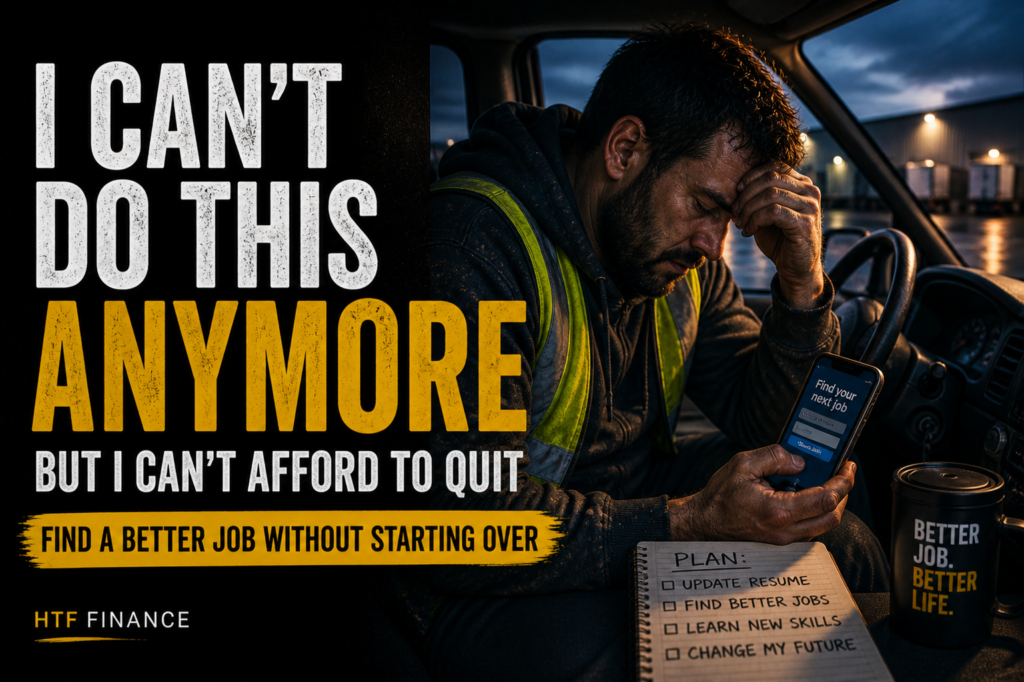

For warehouse workers, delivery drivers, care workers, retail staff, construction workers, and laborers earning under $40k — this one’s for you.
If you’re reading this on a break, between shifts, or lying awake at 2am doing math in your head — you’re not alone. Millions of workers in their 30s and 40s are doing physically hard, mentally draining work every single day and still coming up short. Still one busted knee, one car repair, one unexpected bill away from total disaster.
This isn’t about being bad with money. It’s about a system that was never built with you in mind. But budgeting — done right, with the right tools — is one of the few things you can actually control. Here’s how to start in 2026.
Check out our 6 Month Stability Plan tool for help getting started or head over to money basics.
Free HTF advice
Trying to get your money and career unstuck?
I’m Greg from HTF Finance. I send practical, no-BS advice for working adults who are tired of being told to “just budget better” or “just go back to school” by people who have clearly never had rent, kids, car trouble, and a back that sounds like a haunted staircase.
Join the list for free career path breakdowns, simple money moves, early access to new guides, and first notice when the HTF community opens.
No spam. No lectures. No pretending a side hustle and a spreadsheet can fix a paycheck that is too small.
Is Budgeting Even Worth It When You’re Already Broke?
Yes. And here’s why this question matters: most budgeting advice is written for people who already have breathing room. It assumes you have leftovers to “optimize.” You don’t. What you need is a system built around survival first — and then, slowly, a way out.
Budgeting when you’re broke isn’t about cutting out lattes. It’s about knowing exactly where every dollar goes so you stop being blindsided. That awareness alone reduces financial stress more than most people expect.
What’s the Best Free Budgeting App for Low-Income Workers in 2026?
The three tools worth your time right now are:
YNAB (You Need a Budget) — Best if you want a real system. It’s not free ($109/year), but it pays for itself fast. It forces you to give every dollar a job before you spend it. Thousands of people in tight situations swear by it.
Monarch Money — A strong alternative if you want a clean, visual picture of your money. Syncs your accounts and shows you everything in one place.
Buddy — Completely free, simple, and built for people budgeting paycheck to paycheck. No overwhelming features. Just tracking.
Spreadsheet (Google Sheets) — Free, always. Search “paycheck budget template” and grab one that lists income, fixed bills, and what’s left. Sometimes simple is best.
The best app is the one you’ll actually open. Start free. Upgrade only when you’re ready.
How Do You Budget When Your Income Changes Every Week?
This is the real challenge for gig workers, warehouse staff on variable hours, and seasonal laborers. Here’s the approach that works:
Budget off your lowest paycheck, not your average. If the worst week you had this year was $650 take-home, that’s your baseline. Everything else is a buffer.
List your non-negotiables first: rent/mortgage, utilities, food, transportation to work, minimum debt payments. These come before everything else — always.
Then what’s left gets divided: some to a small emergency fund (even $10 a week adds up), some toward debt, and a small amount for personal spending so you don’t go crazy.
Work with HTF
Need a real plan with step-by-step guidance?
If you’re trying to change careers, fix your money, or both at the same time, you probably don’t need another lecture about discipline. You need someone to help you look at the actual numbers, the actual job options, and the next step that won’t make your life harder.
That’s what Hit The Fan coaching is for. Work with Greg on the 6-Month Stability Plan, one-on-one coaching, or a realistic no-degree career path that fits your actual life.
No lectures. Just the next better step.
What If I’m in Serious Debt and Can’t See a Way Out?
Debt is one of the biggest sources of shame for workers in physically demanding jobs — and one of the least talked-about. Credit cards, medical bills, payday loans. It stacks up fast when you’ve had no cushion.
First step: write it all down. Every debt, every balance, every interest rate. Looking at it directly — instead of avoiding it — is the first act of taking control.
Then pick one method:
- Debt snowball — Pay minimums on everything, attack the smallest balance first. Quick wins keep you motivated.
- Debt avalanche — Pay minimums on everything, attack the highest interest rate first. Saves more money long-term.
Either works. The one you stick with wins.
Also check: are you eligible for any income-based debt relief programs? In 2026, there are still federal and state programs for workers under certain income thresholds. Search “[your state] debt relief program low income worker” — it takes 20 minutes and could save you thousands.
Another option is to simply change careers, if you have no degree we’ve written a blog just for that here.
How Do I Build an Emergency Fund on a Tight Budget
The goal everyone talks about — 3 to 6 months of expenses — is not where you start. That number is paralyzing when you’re earning under $40k and spending every cent.
Start with $500. That’s your first target.
Open a separate savings account (most online banks like SoFi, Chime, or Marcus have no minimums and pay decent interest in 2026). Set up an automatic transfer of even $10 per paycheck. Treat it like a bill. Don’t touch it.
Five hundred dollars won’t solve everything. But it’ll mean the next flat tire doesn’t go on a credit card.
Why This Matters More If You Work a Physical Job
Here’s something nobody says out loud: if you work in a warehouse, on a construction site, driving deliveries, or in care work — your body is your income. One serious injury and the paycheck stops. The bills don’t.
Financial cushion isn’t a luxury for you. It’s insurance. Building even a small emergency fund and reducing high-interest debt is protecting yourself the same way you’d wear PPE. It’s not optional — it’s survival strategy.
The Honest Truth About Financial Freedom in 2026
Financial freedom for most people doesn’t mean retiring at 40 or buying investment properties. For workers earning under $40k, financial freedom means: not panicking when something breaks. Saying no to a shift without losing sleep. Not checking your account balance three times before buying groceries.
That’s a real goal. And it starts with a budget.
Pick one tool. Write down your income and your bills this week. See what’s actually left. That first look is the hardest — and the most important.
Work with HTF
Need a real plan with step-by-step guidance?
If you’re trying to change careers, fix your money, or both at the same time, you probably don’t need another lecture about discipline. You need someone to help you look at the actual numbers, the actual job options, and the next step that won’t make your life harder.
That’s what Hit The Fan coaching is for. Work with Greg on the 6-Month Stability Plan, one-on-one coaching, or a realistic no-degree career path that fits your actual life.
No lectures. Just the next better step.
FAQ: Budgeting for Workers Earning Under $40k in 2026
The zero-based budget or “paycheck budget” method works best — you assign every dollar a purpose as soon as it lands, before you spend anything.
Yes. Base your budget on your lowest expected paycheck, not your average. That way you’re never over-committed.
Stop adding new debt first. Then build a $500 emergency buffer. Then start the debt snowball or avalanche. Don’t try to do everything at once.
Yes. Buddy and a simple Google Sheets template both work without connecting to your bank. Manual entry only.
Most people fail at budgeting because the system they used wasn’t built for their income level. Try a simpler method — cash envelopes or a one-page spreadsheet — before giving up on budgeting altogether.
Yes. Nonprofit credit counseling agencies (look for NFCC members) offer free or low-cost help. Many credit unions also offer free financial coaching to members. In 2026, some employers — especially larger retailers and healthcare systems — offer Employee Assistance Programs (EAPs) that include free financial counseling.
Write down your take-home pay for one month. Write down every bill. Subtract bills from income. What’s left is what you work with. That’s your first budget. Start there.