
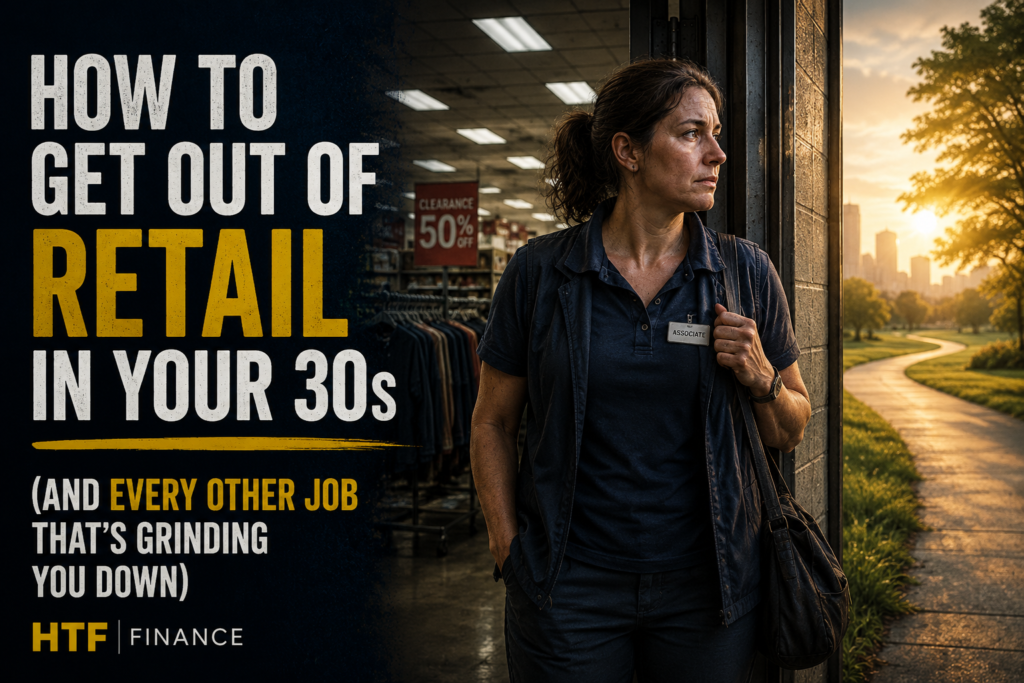
You’re not 22 anymore. Your knees know it. Your back knows it. Your bank account definitely knows it. And somewhere between the third double shift this week and the conversation you overheard about “growth opportunities” — which means nothing because there is no growing up from this floor — a thought crept in.
What if I actually can’t get out?
If you’re in retail, a warehouse, on a delivery route, in construction, caring for people, or doing any job that takes more from your body than it gives back to your wallet — this is for you. Specifically you. Not the hustle-culture crowd. Not people with savings accounts and spare weekends. You.
Because the real question isn’t how to get out of retail. The real question is: how do you get out when you’re exhausted, broke, in debt, and genuinely not sure another life is even available to you?
Let’s talk about that.
Free HTF advice
Trying to get your money and career unstuck?
I’m Greg from HTF Finance. I send practical, no-BS advice for working adults who are tired of being told to “just budget better” or “just go back to school” by people who have clearly never had rent, kids, car trouble, and a back that sounds like a haunted staircase.
Join the list for free career path breakdowns, simple money moves, early access to new guides, and first notice when the HTF community opens.
No spam. No lectures. No pretending a side hustle and a spreadsheet can fix a paycheck that is too small.
Is It Actually Possible to Change Careers in Your 30s or 40s Without a Degree?
Yes. And I’m not going to wrap that in ten qualifiers to protect myself.
I spent over 20 years doing the work. Warehouses, delivery driving, loading trucks, shipping and receiving, production floors — all of it. 12,000 to 15,000 steps a day. Forklifts, cherry pickers, electric pallet jacks. The kind of work that pays in calories burned and pain accumulated.
I left that world in my 40s. No degree. No rich family backstory. No secret advantage. I took an online course in tech sales, got a job offer, and within weeks my 70% take-home — after setting aside taxes — was equal to what I used to bring home working a full two-week pay period at the warehouse.
So yes. It’s possible. But I’m not going to pretend it feels possible when you’re standing in it.
Why Does It Feel Like You’re Stuck Forever?
Because the job is designed to keep you tired. Not out of some conspiracy — just by nature of what it is.
When you’re working 50 or 60 hours a week in a physically demanding job, your weekend isn’t an opportunity. It’s survival. It’s the 48 hours your body uses to become a functioning human again before Monday comes back around.
There’s no mental bandwidth left for “career planning.” There’s barely bandwidth for dinner. Finance influencers and career coaches — the ones who have never actually worked that schedule — will tell you to use your mornings or your lunch breaks. As if you have a lunch break. As if you’re not eating standing up next to a pallet jack.
And then there’s the money part. You can’t just quit. You’re not in a position to take a pay cut to try something new. You might have credit card debt, medical bills, rent that eats 40% of your check, maybe a kid or two who didn’t ask to be factored into your career pivot.
The stuck feeling is real. I’m not going to minimize it. But stuck is a feeling — not a fact.
What Jobs Can You Actually Get Without Going Back to School?
More than you think. And I mean that specifically — not as a motivational line, but as a practical statement about 2026.
The industries that have actively moved away from requiring four-year degrees include tech sales, IT support, customer success, logistics coordination, and digital marketing. These aren’t jobs that got easier. They’re jobs that stopped pretending a diploma was the only proof that someone could think.
What they actually hire for:
— Communication. You talk to people all day already. That’s the job. — Problem-solving under pressure. You do that every shift. — Reliability. Showing up when you don’t want to? Warehouse workers invented that. — A credential from an online course that proves you can learn.
That last one is the key. Not a degree. A course. Self-paced, affordable, completable on your days off without quitting your job.
Work with HTF
Need a real plan with step-by-step guidance?
If you’re trying to change careers, fix your money, or both at the same time, you probably don’t need another lecture about discipline. You need someone to help you look at the actual numbers, the actual job options, and the next step that won’t make your life harder.
That’s what Hit The Fan coaching is for. Work with Greg on the 6-Month Stability Plan, one-on-one coaching, or a realistic no-degree career path that fits your actual life.
No lectures. Just the next better step.
How Do You Find Time to Learn Anything When You’re Working Full-Time?
This is the one that stops most people. And I get it — because I was that person.
When I was in it, I wasn’t looking for a two-hour study block. I was looking for anything that could actually get done between the couch and sleep. What worked was treating it like a second job I was doing for future me. Not every day. Not perfectly. But consistently.
A few things that actually help:
— Self-paced courses are non-negotiable. If something has a fixed schedule that conflicts with your shifts, it’s already dead. — 20 to 30 minutes is enough. You don’t need a full night. You need consistent small chunks. — Phone-first platforms. Learn on your commute. Learn in the parking lot before you go in. Learn on break if you have one. — Pick one path. Not three. The people who say “I’m going to learn coding AND IT AND sales” finish nothing.
You don’t have time to waste on the wrong option. Pick one thing, go deep, and finish it.
Can You Really Get a Remote Job When You’ve Only Ever Worked Physical Jobs?
This one hit me hard personally, because I spent years believing the answer was no.
I used to walk through the warehouse and see the IT guys, the accounting staff, the managers — all in the same building I was sweating in, but living a completely different workday. Hybrid. Comfortable. Not aging at twice the speed. And I thought: that’s not for me. I don’t have the background. I don’t have the degree. I don’t even know how you become someone who gets to do that.
The answer — which I found out later than I should have — is that the same skills that make you good at physical work make you a serious asset in a remote role. You already know how to show up. You already know how to deal with difficult people. You already know how to keep going when things are bad.
What you’re missing is the credential that signals “I can also do the specific tasks of this role.” That’s the gap an online course fills.
What If You’re in Serious Debt — Does That Block You From Changing Careers?
Debt doesn’t disqualify you from changing your income. It makes it more urgent.
Here’s the thing nobody tells you: the job that put you in debt is also the job that’s keeping you in debt. Staying in a role that caps you at $38,000 a year, with no real ceiling, while the cost of everything else keeps climbing — that’s not a debt strategy. That’s a slow bleed.
Changing your income is one of the only actual levers you have. You can budget all you want on $16 an hour, but there’s a floor you can’t budget below. At some point the math doesn’t work and more discipline won’t fix it.
The move: don’t quit your job to study. Study while you’re still working. Apply while you’re still employed. Give yourself a runway. When the income goes up, then you deal with the debt — strategically and with more oxygen to breathe.
Work with HTF
Need a real plan with step-by-step guidance?
If you’re trying to change careers, fix your money, or both at the same time, you probably don’t need another lecture about discipline. You need someone to help you look at the actual numbers, the actual job options, and the next step that won’t make your life harder.
That’s what Hit The Fan coaching is for. Work with Greg on the 6-Month Stability Plan, one-on-one coaching, or a realistic no-degree career path that fits your actual life.
No lectures. Just the next better step.
Is It Too Late to Start Over at 35? At 40? At 45?
The 35-year-old version of me would want to punch me for saying this, so I’m going to say it carefully:
No. It is not too late. But it is later than it could have been — and you should stop waiting for it to feel like the right time, because it never will.
The inner critic hits hardest right here. The voice that says you’re too old, not smart enough, not tech-savvy enough, that no employer is going to take someone like you seriously. I had every one of those thoughts. Word for word.
I did it anyway. And the version of me that got the job offer — fully remote, nearly double the warehouse pay, a few weeks before Christmas — would have a lot to say to the version of me who almost talked himself out of applying.
The economy is hard right now. Hiring is slower. Competition is real. None of that means stop. It means the people who are actually moving are already ahead of the people waiting for things to feel safer.
The best path depends on what you need to fix first. If your body is the problem, start with less physical work careers. If you need the bigger map, use the career change without a degree hub.
The One Thing to Do This Week
Not ten things. One.
Search “tech sales course” or “IT support course for beginners” and look at what a self-paced, under-$500 option covers. Read it. All the way through. Don’t sign up for anything yet — just read it. See if it feels like something a human being could actually do.
Because here’s what I know from the other side: the jump from “maybe I could” to “I’m doing it” almost never happens in one big moment. It happens because someone, somewhere, on a tired Tuesday night, read something that made them think: okay, that’s actually possible.
Let this be that Tuesday.
This is my personal experience and opinion — not professional financial or career advice. Always do your own research.
Frequently Asked Questions
You don’t need a degree to exit retail. Self-paced online courses in fields like tech sales, IT support, or customer success can qualify you for entry-level remote roles that pay significantly more than most retail positions. The key is completing one course, building a basic resume around transferable skills, and applying while you’re still employed.
Workers leaving retail in their 30s often transition into tech sales, IT help desk, logistics coordination, remote customer success roles, and B2B account management. These fields actively hire people with strong interpersonal skills and a track record of reliability — both of which retail and service workers have in abundance.
Yes, and increasing your income is often the most effective way to actually address debt. Staying in a capped-income role while inflation and bills rise is not a financial strategy. Transitioning to a higher-paying career — without quitting your current job until you have an offer — gives you more room to pay down debt faster.
Timeline varies, but many people complete entry-level tech sales or IT support courses in two to four months of part-time study. Job searching after completion can add another one to three months. The full process from starting a course to receiving an offer is commonly six to nine months, though some people move faster depending on market conditions and how aggressively they apply.
The job market in 2026 is slower and more competitive than it was a few years ago. That’s real. However, people transitioning out of physical labor into roles that require communication skills and reliability are still finding positions — particularly in tech-adjacent and remote-first fields. The advantage workers from physical jobs have is a demonstrated ability to show up and perform under pressure, which many hiring managers value more than a credential alone.
Self-paced options designed for working adults include courses in tech sales fundamentals, CompTIA A+ for IT support, and Google career certificates in project management or data analytics. Platforms like Coursera, Udemy, and CourseCareers are worth looking at. Prioritize courses that are self-paced, under $500, and include some job search guidance.
Frame your experience around transferable skills: inventory management, team coordination, meeting targets under pressure, customer interaction, and performing in fast-paced environments. Pair that with your online course credential and any practice work you completed during it. Employers in sales and support roles understand labor backgrounds — your job is to help them see the connection.