
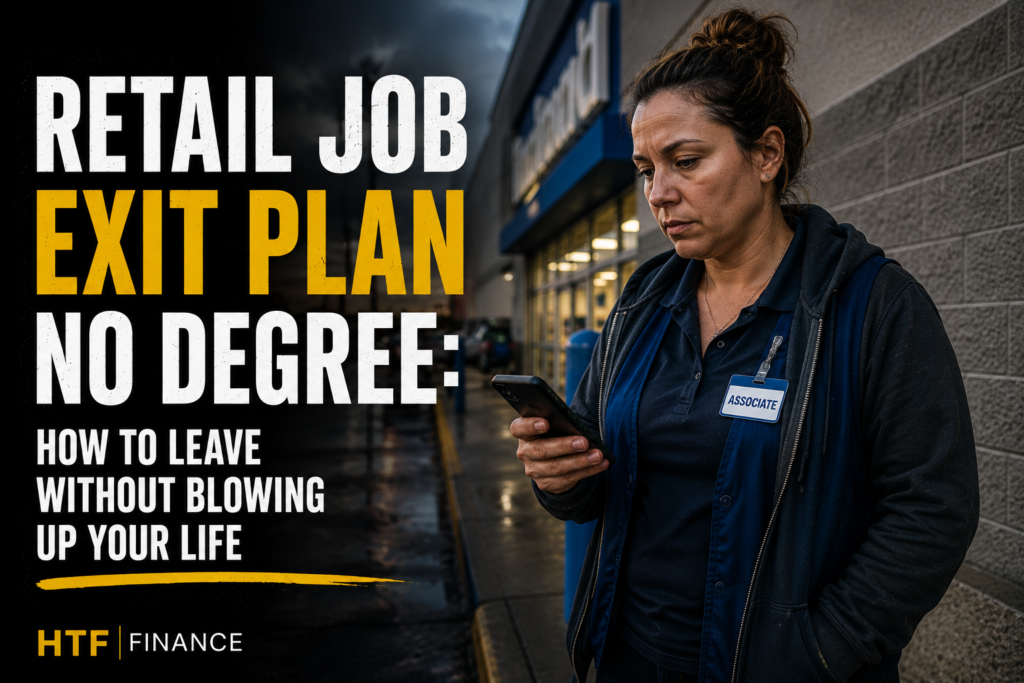
You’re in your 30s or 40s. Your knees hurt. Your back is shot. You’re scanning barcodes, lifting boxes, driving routes, or wiping down surfaces for people who will never learn your name — and you are doing this while the rent is late, the credit cards are bleeding, and your body is sending you signals you’re starting to ignore.
You don’t need a motivational speech. You’ve heard those. They don’t pay bills.
What you need is a realistic answer to a real question: Is there actually a way out of this — without a college degree, without a trust fund, and without quitting your job before you have something lined up?
Yes. There is. And it doesn’t require you to have extra money you don’t have, or free time you definitely don’t have.
But it does require you to stop waiting for something to change on its own. Because it won’t.
Free HTF advice
Trying to get your money and career unstuck?
I’m Greg from HTF Finance. I send practical, no-BS advice for working adults who are tired of being told to “just budget better” or “just go back to school” by people who have clearly never had rent, kids, car trouble, and a back that sounds like a haunted staircase.
Join the list for free career path breakdowns, simple money moves, early access to new guides, and first notice when the HTF community opens.
No spam. No lectures. No pretending a side hustle and a spreadsheet can fix a paycheck that is too small.
Why Does It Feel Impossible to Leave a Physically Demanding Job Right Now?
Because 2026 is genuinely brutal for a lot of people and the people telling you to “just find something better” have never stood on concrete for ten hours or worked a double shift with a sinus infection because calling out meant you’d lose the $1 shift differential you’d been promised for six months.
The economy right now isn’t handing out opportunities. A lot of hiring freezes are still happening. Job postings are down in several industries. And if you’ve been in warehouse work, retail, delivery, caregiving, or construction your whole adult life, your resume doesn’t exactly scream “hire me for the remote position.”
That’s real. That’s not you being negative. That’s just the math.
But here’s what’s also true: the people who are getting out right now — and some of them are — started learning something 6 to 12 months before they made a move. They didn’t quit cold. They didn’t gamble. They got a little bit prepared, quietly, while still showing up to the job they hated.
That’s the move.
Can You Actually Get a Better-Paying Job Without a Degree in Today’s Market?
Shorter answer than you’d expect: yes, if you go after the right sectors.
The problem isn’t that no-degree jobs don’t exist. The problem is that most people who want out of physical labor look at the same tired options — maybe a GED program, maybe a trade, maybe a “certificate” they’ve never heard of — and nothing lands.
The sectors that are actually accessible right now, without a degree, with courses that cost a few hundred dollars instead of tens of thousands, are: tech sales (specifically B2B software sales), IT support roles, customer success, and some administrative operations work. These aren’t glamour jobs. But they’re desk jobs. Or laptop-on-couch jobs. And they pay more than $14 an hour.
Tech sales specifically has an open door for people who are good with people, can explain things clearly, and don’t mind making phone calls. That sounds like someone who’s dealt with angry customers, managed deliveries under pressure, and problem-solved on a warehouse floor every single day. That sounds like you.
The barrier isn’t your intelligence. The barrier is that nobody told you this door existed.
What Does a Realistic Exit Plan Actually Look Like for Someone Earning Under $40k?
Here’s the honest version — not the polished version:
Step one is 15 minutes a day. Not 4 hours. Not a full weekend commitment. Fifteen minutes before work, during a break, or after the kids are down. That’s where this starts. You’re not going back to school. You’re taking a focused online course on one specific, employable skill.
CourseCareers is one option — their tech sales program runs around $500 and is self-paced. There are options to pay in installments. LinkedIn Learning, Coursera, and Google’s free certificate programs are also real and respected by employers. You do not need to spend thousands.
Step two is a resume that doesn’t sink you. Most people in physically demanding jobs undersell the hell out of themselves on paper. “Managed inventory processes for a facility processing 3,000+ units per day” sounds a lot better than “stocked shelves.” That reframe is free. It just takes someone showing you how.
Step three is LinkedIn — even if you hate it. A half-filled profile is invisible. A complete one with the right keywords gets you found. You don’t have to post anything. You just have to exist on there in a way that makes you searchable.
Step four is applying before you feel ready. You will never feel ready. The imposter syndrome is louder for people who came up through labor jobs — because you’ve spent years being treated like your intelligence doesn’t matter. It does. Apply anyway.
If you want the broader map, start with the career change without a degree hub. If retail has your body, schedule, or nervous system cooked, also look at less physical work careers.
Work with HTF
Need a real plan with step-by-step guidance?
If you’re trying to change careers, fix your money, or both at the same time, you probably don’t need another lecture about discipline. You need someone to help you look at the actual numbers, the actual job options, and the next step that won’t make your life harder.
That’s what Hit The Fan coaching is for. Work with Greg on the 6-Month Stability Plan, one-on-one coaching, or a realistic no-degree career path that fits your actual life.
No lectures. Just the next better step.
How Long Does It Actually Take to Get Out?
Realistically, if you start today and stay consistent? Six months to a year before your first interview in a new field. Possibly faster if you’re aggressive about it. Possibly longer if life gets in the way — and for people working 50-hour weeks with kids and debt, life always gets in the way.
The point isn’t speed. The point is motion. The people who never get out are the ones who spend five years saying they’ll start when things calm down. Things don’t calm down. You start in the middle of the chaos, or you don’t start.
What If You’re Buried in Debt and Have No Savings to Fall Back On?
Then you don’t quit your job first. That is the most important thing I can tell you.
You learn the new skill while employed. You apply while employed. You interview while employed. If that means scheduling an interview on your lunch break in a parking lot, that’s what it means. You do not give notice until you have an offer in hand.
On the debt side: you don’t need to be debt-free to start a career pivot. But you do need to know exactly what you owe and to whom, because that affects how much runway you have if something goes sideways. Write it down. One list. All of it. It’s terrifying for about ten minutes and then it becomes a problem you can actually solve instead of a fog that’s constantly stressing you out.
The debt snowball approach — paying off the smallest balance first to build momentum — actually works for people who need a psychological win, not just a financial one. Which is most of us.
Start with the retail and customer service career change guide if you want retail-specific options. Use the career change without a degree hub if you want the broader map. If the money side is making every decision feel impossible, start with money basics.
The One Thing You Can Do Today
Go to coursecareers.com or google.com/certificates and spend 20 minutes looking at what’s there. Not committing. Not enrolling. Just looking.
That’s it. That’s the first move.
The version of you that’s still doing this job at 50 didn’t do anything dramatically wrong. They just never took the first step because it never felt like the right time. The right time is not coming. The first step is.
This post reflects personal experience and honest opinion — not licensed financial or career advice. Do your own research before making any major financial or career decision.
Work with HTF
Need a real plan with step-by-step guidance?
If you’re trying to change careers, fix your money, or both at the same time, you probably don’t need another lecture about discipline. You need someone to help you look at the actual numbers, the actual job options, and the next step that won’t make your life harder.
That’s what Hit The Fan coaching is for. Work with Greg on the 6-Month Stability Plan, one-on-one coaching, or a realistic no-degree career path that fits your actual life.
No lectures. Just the next better step.
Frequently Asked Questions
Yes. Several remote job categories — including tech sales, IT support, customer success, and virtual administrative work — do not require a four-year degree. Many employers in these fields have shifted toward skills-based hiring, meaning certifications and demonstrable ability matter more than educational credentials. Targeted online courses in specific fields can provide the foundation needed to compete for these roles.
Tech sales and IT support roles are two of the most commonly cited entry points for workers making a career change from physical labor. Both have structured online training programs designed for career changers. Tech sales in particular values communication skills and empathy — traits that transfer well from customer-facing or team-based labor roles. The learning curve is real but manageable without a degree.
The key is building a skill and securing an offer before resigning. Leaving without income lined up amplifies financial risk significantly. The practical approach is to start a self-paced course during off-hours — before or after shifts, on days off — while maintaining current employment. Job applications and interviews can be arranged around existing schedules. A job offer, not a plan, is what triggers giving notice.
Employer acceptance of online credentials has grown substantially over the past several years, particularly in tech-adjacent fields. Programs from Google, Coursera, LinkedIn Learning, and targeted providers like CourseCareers have demonstrated outcomes for adult learners in career transition. The ROI depends on the field — courses aimed at in-demand roles with clear hiring pipelines tend to justify the cost far more than general interest certifications.
No. Career transitions in the 40s are common, particularly for workers in physically demanding fields dealing with health-related limitations or financial pressure. The challenge at 40 is different from the challenge at 25 — there are typically more obligations, less flexibility, and less tolerance for failure. But the skills accumulated over two decades in labor environments — reliability, pressure management, physical and logistical problem-solving — are genuinely transferable. The career pivot requires strategy, not a time machine.
The fastest realistic path is identifying one specific role type, finding the most direct credential or training program for that role, completing it while employed, and applying with a targeted resume. Trying to explore too many options simultaneously slows the process. Choosing one direction — even imperfectly — and moving toward it consistently produces faster results than waiting for the perfect plan.
Entry-level tech-adjacent roles — particularly in sales development, IT help desk, and customer support — are designed for candidates without prior industry experience. These positions typically prioritize aptitude, communication ability, and cultural fit over a specific educational background. Many workers who have successfully transitioned from labor to tech-adjacent roles report that practical problem-solving experience from their previous work was an asset in hiring conversations.