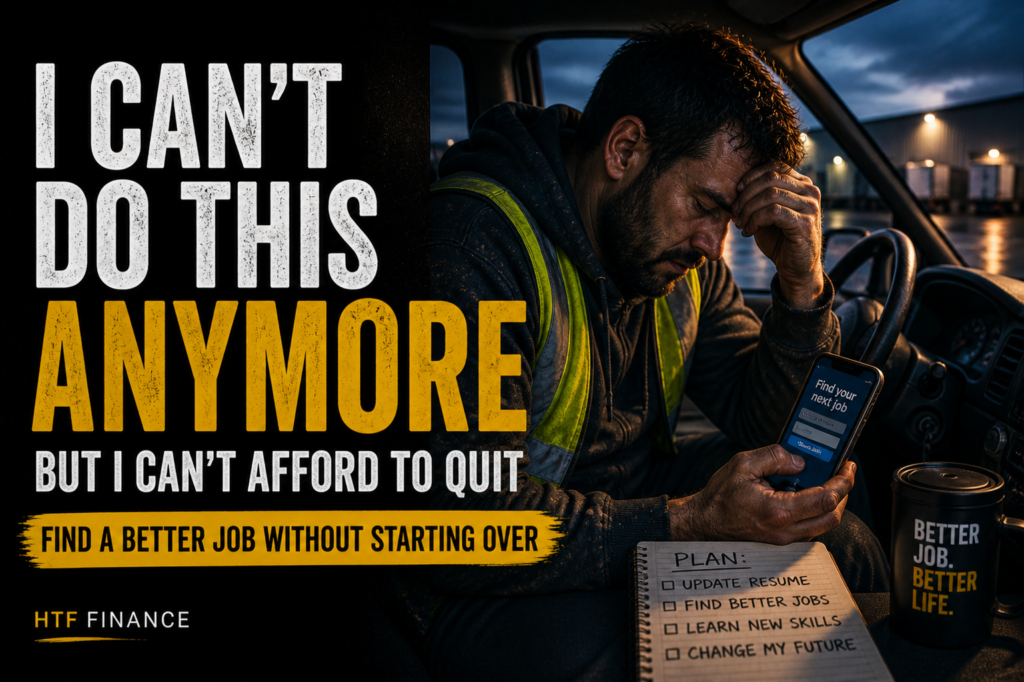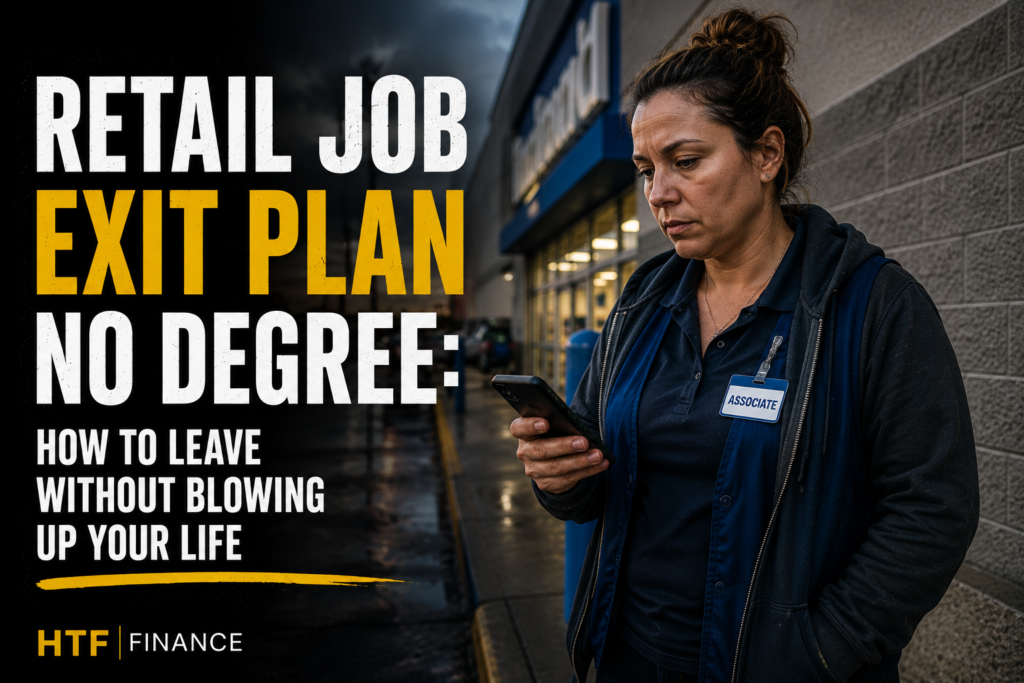

You wake up at 5am. Your knees already hurt before you’ve put your feet on the floor. You’ve got $47 in your checking account, a credit card you stopped opening the statements on, and a job you’re going to anyway — not because you want to, but because you literally cannot afford not to.
You hate it. And you’ve hated it for years.
But here’s the thing nobody says out loud: you don’t actually hate work. You hate being trapped in work that’s destroying your body, paying you just enough to keep you stuck, and has absolutely no horizon. You hate the feeling that this is just… it. That you missed some window somewhere. That people without a degree don’t get second chances at 37.
That’s the lie we need to talk about.
This is peer coaching based on lived experience — not licensed career or financial advice. Always do your own research.
Free HTF advice
Trying to get your money and career unstuck?
I’m Greg from HTF Finance. I send practical, no-BS advice for working adults who are tired of being told to “just budget better” or “just go back to school” by people who have clearly never had rent, kids, car trouble, and a back that sounds like a haunted staircase.
Join the list for free career path breakdowns, simple money moves, early access to new guides, and first notice when the HTF community opens.
No spam. No lectures. No pretending a side hustle and a spreadsheet can fix a paycheck that is too small.
Is It Too Late to Change Careers Without a Degree?
No. And I’m not saying that to make you feel better — I’m saying it because I lived it.
I spent over 20 years in labor. Warehouse. Delivery driver. Shipping and receiving. Forklift, cherry picker, electric pallet jack — the whole lineup. I was logging 12,000 to 15,000 steps a day, working 40 to 70-plus hours a week, and doing the kind of work that doesn’t just tire you out — it takes something from you permanently. Your back. Your knees. Your sleep.
I was in my early 40s when I finally got out. Fully remote job in tech sales. Nearly double what I was making. No degree. Online courses only.
If I had known in my 30s that this was actually possible, I would have done it then. I would have gone into coding years sooner. But I didn’t know, because nobody in my world was talking about it.
That’s what this is. Someone in your world, talking about it.
Why Do People in Physical Jobs Feel So Stuck?
Because the trap is real — and it’s designed to keep you in it.
Here’s how it works: you’re making just enough that you can’t save anything, but not so little that you qualify for help. You’re exhausted from 50-hour weeks, so the weekend is recovery, not opportunity. Every time you think about going back to school, you look at the cost and the timeline and you close the tab. And every year that goes by, the voice in your head gets louder — you’re too old now, you missed it, this is just who you are.
That voice is lying to you. But it’s hard to hear anything else when you’re running on four hours of sleep and your feet hurt.
The stuck feeling is the most common thing I hear from people in physically demanding jobs. Not laziness. Not lack of ambition. The stuck feeling — the one that says I can’t do anything better than this. That mindset is what finance bros and career coaches miss entirely, because they’ve never been in it. Not on that level.
I’ve been in it. I know what it actually costs you, and I’m not talking about money.
What Happens to Your Body Working Physical Jobs Into Your 40s?
Nothing good.
You already know this. You feel it every morning. The thing nobody prepares you for is that it’s not dramatic — it’s slow. One year your knee is a little sore. A couple years later you’re icing it every night. A couple years after that, you’re getting a cortisone shot and wondering how much longer you can do this.
I had a moment at work — two hours into a shift, bad sinus infection, severely dehydrated, company under threat of shutdown — where I felt my heart racing, my hands tingling, tunnel vision going white. I genuinely thought I was having a heart attack. I was on the warehouse floor.
That was the day I said: I cannot do this.
Not “I should probably think about other options.” I cannot do this. It is going to kill me.
Maybe you haven’t had that moment yet. Maybe you’ve had three of them. Either way — your body is keeping score, and physical jobs don’t let you pay the tab later.
Work with HTF
Need a real plan with step-by-step guidance?
If you’re trying to change careers, fix your money, or both at the same time, you probably don’t need another lecture about discipline. You need someone to help you look at the actual numbers, the actual job options, and the next step that won’t make your life harder.
That’s what Hit The Fan coaching is for. Work with Greg on the 6-Month Stability Plan, one-on-one coaching, or a realistic no-degree career path that fits your actual life.
No lectures. Just the next better step.
Can You Actually Get a Better Job Without a College Degree in 2026?
Yes, and the people who will tell you otherwise have never had to try.
The job market in 2026 is rough. Everyone knows that. But “rough” doesn’t mean closed, and it doesn’t mean the only path is one that requires a four-year degree you can’t afford and don’t have time for.
There are entire fields that are hiring, that pay well, and that actively do not require a degree — they require skills. Skills you can learn online, on your own schedule, for a few hundred dollars. Not thousands. Not years.
Tech sales. IT support. Digital marketing. Project coordination. Customer success. Some of these have certification programs you can finish in a few months. Some of them are actively recruiting people who can communicate well, handle pressure, and show up — which, if you’ve been working in a warehouse for a decade, you can absolutely do.
The companies running those roles have also figured out that a guy who’s been managing 200 orders a day on a warehouse floor, dealing with angry drivers and impossible deadlines, has more real-world skills than someone who interned at a startup and got a degree in communications. They just want proof you can do the job.
That proof doesn’t have to come from a university.
What Do You Do When You’re Living Paycheck to Paycheck and Can’t Save Anything?
You work with what you actually have, not what the finance content says you should have.
Most personal finance advice is written for people with discretionary income — money left over after the bills are paid. If you’re earning under $40k and working physical labor, that description doesn’t fit you, and a lot of the standard advice won’t either. You cannot “cut your lattes” your way out of a $14-an-hour job.
What you can do is stop the bleeding in the places it’s quiet enough to find.
Do you have subscriptions you forgot about? Are you carrying a balance on a card that’s charging you 27% interest while you make minimum payments? Are there small recurring charges on your account you stopped noticing? Start there. Not because it changes everything overnight — it won’t — but because taking any small amount of control over your money starts to break the feeling that you have none.
That feeling — the “why bother, I’m underwater anyway” feeling — is what keeps people stuck financially just as much as the actual math does. I know because I’ve been there. After my mom passed, I was alone, behind on everything, and spending what little I made at bars every night on the way home from work. I knew I was doing it. I did it anyway. The math actually could have worked out — the money was technically there to pay things off — but the mindset wasn’t.
The math doesn’t fix itself until the mindset shifts.
Is There Any Hope for Someone Who’s Behind on Everything?
Yes. And I don’t mean that in a poster-on-the-wall kind of way.
I mean: I didn’t have a five-figure emergency fund until I was in my 40s. I mean: I estimate I’m about $400,000 behind where I should be for retirement. I mean: I paid for my mother’s funeral out of pocket with money I didn’t have because her life insurance didn’t cover it. I mean: I’ve been exactly where you are, and I’m not.
None of that got fixed in a month. None of it was clean or linear. But it moved — and it moved because I stopped waiting for someone to hand me the instruction manual and started making one decision at a time.
The first real decision I made was finding a debt payoff method that made sense to me — the debt snowball, if you’re looking for a starting point. Smallest balance first. One win leads to the next. It’s not magic, but it’s real, and the feeling when you pay off that first account is something I genuinely wasn’t prepared for. It felt like something I had been carrying finally got set down.
You don’t need everything figured out to start.
What’s the One Thing Someone in a Dead-End Job Can Do Right Now?
Look at one online course. Just one.
Not to enroll. Not to commit to anything. Just to look at what it costs, how long it takes, and what the end of it looks like. CourseCareers. Google Career Certificates. LinkedIn Learning. There are programs that cost a few hundred dollars and take a few months that train people for jobs in tech support, digital marketing, and business operations.
That’s it. That’s the action. Spend 20 minutes tonight looking at one program like it’s actually for you — because it is.
The path exists. Other people like you have taken it. I took it. The door is open. You just have to look at it long enough to stop believing it’s locked.
This is peer coaching based on lived experience — not licensed career or financial advice. Always do your own research.
Work with HTF
Need a real plan with step-by-step guidance?
If you’re trying to change careers, fix your money, or both at the same time, you probably don’t need another lecture about discipline. You need someone to help you look at the actual numbers, the actual job options, and the next step that won’t make your life harder.
That’s what Hit The Fan coaching is for. Work with Greg on the 6-Month Stability Plan, one-on-one coaching, or a realistic no-degree career path that fits your actual life.
No lectures. Just the next better step.
Frequently Asked Questions
Yes. Many fields, including tech sales, IT support, digital marketing, and customer success, hire based on skills and certifications rather than a four-year degree. Online programs from providers like Google, CourseCareers, and LinkedIn Learning offer training that takes months, not years, and costs a fraction of a traditional degree. In 2026, employers are increasingly evaluating candidates on demonstrated skills and practical experience.
Workers with backgrounds in warehouse operations, delivery, or physical labor often have transferable skills that translate well into logistics coordination, customer support, operations roles, and entry-level tech sales or IT support. These industries value reliability, problem-solving under pressure, and communication — all of which workers in physical jobs develop on the job every day.
The most realistic approach is to begin a transition while still employed. Use evenings or weekends — even 30 to 60 minutes a few times a week — to complete an online skills program. Apply for new roles before leaving your current one. Most people who successfully change careers do it with a job to fall back on, not by walking out.
Start by stopping the bleeding — identify any recurring charges, subscriptions, or minimum payments on high-interest debt that can be addressed first. The debt snowball method, which involves paying off your smallest balances first to build momentum, is one approach that has worked for people in similar situations. The goal is not to have it all figured out immediately, but to take one real step.
No. Career pivots in the late 30s and 40s are increasingly common, and many online training programs are specifically designed for working adults who need a flexible schedule. The skills gap in tech, healthcare administration, and business operations means there is genuine demand for people who are willing to learn — regardless of age or educational background.
Google Career Certificates offer training in IT support, data analytics, project management, and digital marketing. CourseCareers offers tech sales and IT training designed for people without degrees. LinkedIn Learning offers a wide range of business and technical skills with a certificate upon completion. Many of these programs cost a few hundred dollars or less and can be completed in a few months.
That feeling is extremely common among adults in physically demanding, low-wage work — and it is not an accurate reflection of reality. It is a product of exhaustion, financial stress, and the absence of proof that a different path exists. The most reliable way to begin dismantling it is to find specific examples of people who were in the same situation and made a change. That proof matters. When you see it, the voice quiets — not all at once, but enoug