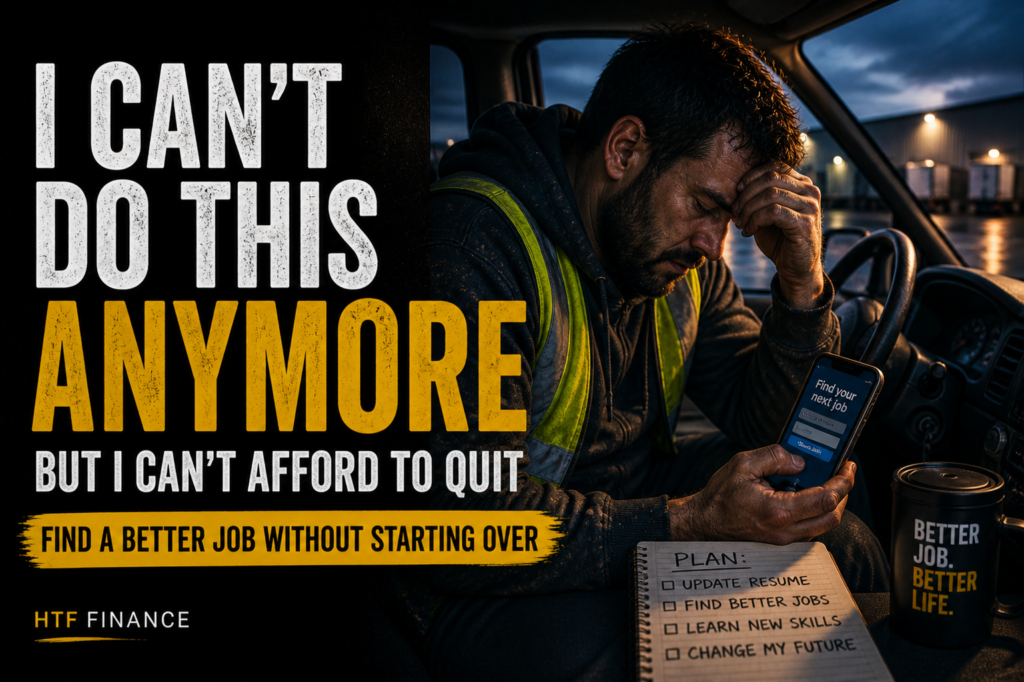

You’re in your 30s or 40s. Your knees ache before noon. You’ve done the math on your paycheck so many times you’ve got the numbers memorized — and they still don’t add up. You’re working a job that takes more from your body every year than it puts into your bank account, and somewhere in the back of your head a voice keeps saying: there has to be a way out of this.
There is. And you don’t need a degree to find it.
But let me be honest with you first — because the internet is full of people selling you a dream without telling you what the road actually looks like. I spent over 20 years in warehouses, loading docks, and distribution centers. I know what it feels like to get a “raise” after a year of hard work and end up making less than when you started because the company quietly changed your shift time. I know what it’s like to sit in a mandatory meeting and get told you have exactly one sick day left for the next nine months — no matter what happens to your body or your family.
I got out. And I’m going to tell you how — because nobody told me, and it cost me years.
Free HTF advice
Trying to get your money and career unstuck?
I’m Greg from HTF Finance. I send practical, no-BS advice for working adults who are tired of being told to “just budget better” or “just go back to school” by people who have clearly never had rent, kids, car trouble, and a back that sounds like a haunted staircase.
Join the list for free career path breakdowns, simple money moves, early access to new guides, and first notice when the HTF community opens.
No spam. No lectures. No pretending a side hustle and a spreadsheet can fix a paycheck that is too small.
Why Does It Feel Impossible to Leave a Physically Demanding Job in 2026?
Because it kind of is. Let’s just say that out loud.
The economy in 2026 is not forgiving. Inflation ate your raises before you got them. Entry-level remote jobs are flooded with applicants. Housing costs haven’t budged. A lot of people in physically demanding jobs — warehouse workers, delivery drivers, care workers, construction laborers, retail staff — are carrying debt that makes any kind of “investment in yourself” feel like a sick joke. You’re not being dramatic. The math genuinely is harder right now.
But here’s the thing: the path out doesn’t require money you don’t have. It requires time you have to carve out, energy you have to protect, and information that, until now, maybe nobody bothered to give you.
Can You Actually Leave a Labor Job Without a College Degree?
Yes. Full stop.
The degree myth is one of the most damaging things keeping working-class people stuck. You’ve been told — directly or indirectly — that without a four-year degree, you’re limited to what you can already do. That’s not true, and it hasn’t been true for about a decade.
Tech sales. IT support. Customer success roles. Project coordination. Remote operations jobs. These are real positions, with real salaries — often double what you’re making now — and many of them can be entered through a combination of online courses, certifications, and a resume that actually tells your story right.
The people who got those jobs? Some of them came from warehouses, kitchens, delivery routes, and care facilities. The skills you already have — managing pressure, communicating under stress, solving problems with limited resources, showing up when it’s hard — those translate. They just need to be framed correctly.
What’s the Realistic First Step When You’re Living Paycheck to Paycheck?
Not what most finance or career people tell you. They’ll say “build an emergency fund first” or “take a class on your lunch break.” Cool advice if you’re not working 50-hour weeks and coming home with nothing left in the tank.
Here’s what’s actually realistic:
Pick one direction — just one. Not “a better career.” Something specific. Tech sales. IT helpdesk. Supply chain coordinator. Medical billing. Remote customer service at the enterprise level. One thing you can point at and say that.
Then find one resource. A $500 course is too much right now? There are courses under $50. Some are free. CourseCareers, Google Career Certificates, LinkedIn Learning with a library card — these exist. You don’t have to commit to a year of night school. You can commit to 30 minutes on a Tuesday night after the kids are in bed.
The debt isn’t going anywhere on its own. But a skill you build over six months can open a door that changes the income side of the equation entirely — and that’s the only real way to get ahead when your budget has no slack.
If money stress is making every career decision feel like a house fire, start with money basics or look at the 6-Month Stability Plan.
Work with HTF
Need a real plan with step-by-step guidance?
If you’re trying to change careers, fix your money, or both at the same time, you probably don’t need another lecture about discipline. You need someone to help you look at the actual numbers, the actual job options, and the next step that won’t make your life harder.
That’s what Hit The Fan coaching is for. Work with Greg on the 6-Month Stability Plan, one-on-one coaching, or a realistic no-degree career path that fits your actual life.
No lectures. Just the next better step.
Does Age Actually Matter When You’re Trying to Change Careers?
The fear that you’re too old is real, and it’s also wrong.
I know that’s easy to say. But I took my first tech sales interview at 42. Got the offer. Started a job that paid nearly double what I was making in the warehouse, fully remote, a few weeks before Christmas. The voice in my head had been saying for years that I was too old, too uneducated, that no one would take me seriously, that I’d bomb the interview.
I did it anyway.
You are not too old. You’re experienced. You understand accountability, physical consequences, and what it means to show up when you don’t want to. That’s not nothing — in fact, a lot of people entering white-collar jobs from comfortable backgrounds don’t have it.
What you have to confront is the belief that the version of you standing on a concrete floor right now is the final version. It isn’t.
How Do You Stay Motivated When You’re This Exhausted and This Deep in Debt?
You don’t always. That’s the honest answer.
Some weeks you won’t open the course. Some nights the couch wins. That’s not failure — that’s a body that gave everything it had to a job that didn’t give it back.
What keeps you going isn’t motivation. It’s a decision you make once — and then recommit to every time things get hard. The decision that you are not going to be in this exact spot in two more years. That the debt is going to shrink. That the body you’re spending right now on a job that would replace you in a week deserves something better.
When I was at my worst — working sick, watching a raise turn into a pay cut, getting told exactly how little my health mattered to my employer — I didn’t feel motivated. I felt like this was just my life and it wouldn’t get better.
It got better. Not fast. Not without setbacks. But it did.
What Should You Actually Do This Week?
One thing. Just one.
Go to Google and search “CourseCareers” or “Google Career Certificate.” Pick a track that sounds even remotely interesting. Read the overview. Don’t sign up for anything yet. Just read it.
That’s it. That’s the whole assignment.
The exit plan doesn’t start when you have money, when the debt is gone, when things calm down. It starts with five minutes of information on a Thursday night. That’s where I started. That’s where most people start.
You don’t have to have it figured out. You just have to start.
This is personal experience and opinion — not licensed financial or career advice. Always do your own research before making any career or financial decision.
Work with HTF
Need a real plan with step-by-step guidance?
If you’re trying to change careers, fix your money, or both at the same time, you probably don’t need another lecture about discipline. You need someone to help you look at the actual numbers, the actual job options, and the next step that won’t make your life harder.
That’s what Hit The Fan coaching is for. Work with Greg on the 6-Month Stability Plan, one-on-one coaching, or a realistic no-degree career path that fits your actual life.
No lectures. Just the next better step.
Frequently Asked Questions
People leaving physically demanding labor jobs without degrees have successfully moved into tech sales, IT support, remote customer service, supply chain coordination, medical billing, and project management roles. The most accessible entry points in 2026 are typically tech sales representative positions and IT helpdesk roles, both of which can be entered through short-form online courses and certifications costing under $500.
Most people who successfully transition from manual labor to remote or hybrid office work spend between three and twelve months preparing — completing a course, getting a certification, and applying. The timeline depends heavily on how many hours per week you can commit to learning and how quickly you can update your resume and begin applying. Some people move faster; some take longer based on their debt load, schedule, and family obligations.
The question isn’t really whether to leave immediately — it’s whether to start building the skills and credentials for an exit while you’re still employed. Most career coaches and people who’ve made this transition successfully recommend preparing for six to twelve months before leaving, so you have a job offer lined up before you walk out. In a difficult economy, the risk of an unprepared leap is real. The risk of staying in a physically unsustainable job for another five years is also real.
Courses that have produced results for people in working-class labor jobs include CourseCareers for tech sales, Google Career Certificates for IT support and project management, and CompTIA A+ certification materials through Udemy for IT helpdesk roles. LinkedIn Learning is accessible for free through many public library systems. The best course is the one you can actually finish given your current schedule — short, focused, and self-paced tends to work better than long-form academic programs.
A course in the $50–$500 range is accessible for most budgets over a period of two to three months of setting aside a small amount. Free options exist through library systems and Google’s certificate programs. The bigger barrier is usually time and energy, not money. For debt, the debt snowball method — paying off smallest balances first to build momentum — has helped many people in this situation create enough breathing room to invest in themselves without waiting until the debt is fully cleared.
Yes. Tech sales — particularly B2B software sales — rewards communication skills, empathy, and the ability to understand a customer’s problem. People who have worked physically demanding jobs often have strong communication skills under pressure, a real understanding of operational challenges, and a work ethic that stands out in interview settings. Several people who made this transition were in their late 30s or early 40s with no tech background. The entry-level SDR and BDR roles in tech sales specifically look for coachability and communication ability over technical expertise.
The debt snowball method involves listing all debts from smallest to largest balance, making minimum payments on everything, and putting any extra money toward the smallest debt first. Once that’s paid off, you roll that payment into the next smallest balance. For people earning under $40,000, the challenge is finding that extra money — but even $20 to $50 per month applied consistently to the smallest debt creates early wins that shift your mindset and build momentum. The psychological effect of eliminating individual debts — even small ones — is the core mechanism that makes the method effective for people who have previously felt stuck.